
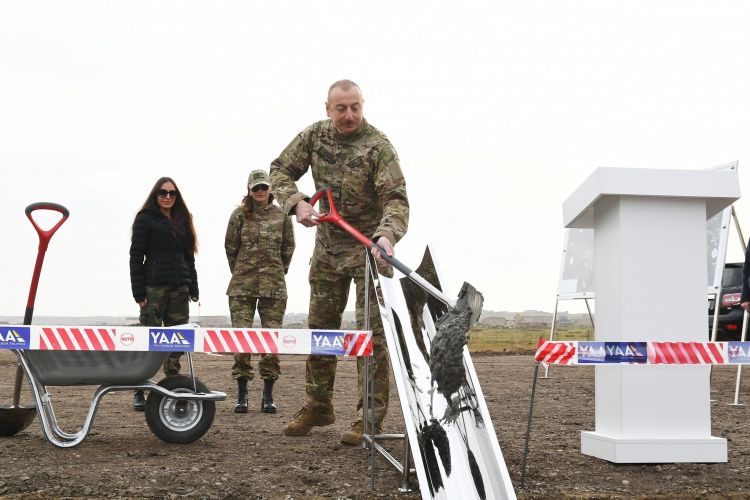
The “reconstruction” of the newly liberated areas of Azerbaijan is in full “swing”. New lines of communications, roads, super highways, homes and people’s welfare centers are being carried out through concerted efforts in these areas due to which their economic potentials have been further “strengthened”, “streamlined” and “systematized”.
These vast and scattered areas have now become new “connecting hubs” for Azerbaijan. Thus, horrendous crimes of Armenia could not discourage the visionary leadership of Azerbaijan H.E. Ilham Aliyev to stay away from transforming all these areas of “HEAVENS” on earth.
The large-scale resettlement of Azerbaijan people to the newly-liberated areas through “Sustainable Settlement” while “reintegrating” economic activity, is one of Azerbaijan's five national priorities outlined in the country's "2030 Strategy," which has been based on the United Nations' “Transforming our World: The 2030 Agenda for Sustainable Development.”
Most recently, the Republic of Azerbaijan has celebrated its National Day. Its constant “Structural Reforms” and “Visionary Leadership” has made it the “Largest Economy” and “GDP” of the South Caucasus and newly liberated areas have now become a “strategic” value addition in this regard.
In addition to this, most recently Azerbaijan’s President Ilham Aliyev signed a new decree and allocated an additional five million manats ($2.94 million) to accelerate the ongoing restoration work and launch new projects in the country’s liberated lands.
According to it the funds will be spent on designing and carrying out construction works, repair, and restoration in settlements, cities, villages, and towns in the Karabakh and East Zangazur economic regions.
Moreover, President Aliyev also signed decrees on the allocation of a total of 600,000 manats ($352,000) for the reconstruction and restoration of two secondary schools in the Kalbajar and Zangilan regions.
In 2021 & 2022, the Azerbaijani government allocated a total of 4.9 billion manats, or nearly $2.8 billion to the large-scale reconstruction and restoration activities in the liberated lands.
After the peace agreement between Armenia and Azerbaijan in November 2020, the latter immediately set to work on the “decontamination”, “reconstruction”, “rehabilitation” and “reintegration” of liberated Karabakh, which had suffered enormous destruction over the course of the Armenian occupation over the last 30 years.
Since 2020, dozens of projects have been completed by the Azerbaijan government, while many others are being carried out.
The State Agency of Automobile Roads of Azerbaijan (AAYDA) has rolled out 13 projects for laying a total of 725 kilometers of new roads and highways, as well as restoring the existing routes in the liberated lands.
In November 2021, President Ilham Aliyev inaugurated the “Victory Road” stretching from Fuzuli District to the city of Shusha on a 101 kilometer route. In the same year, President Aliyev launched the renovated 28.5-kilometer highway leading to the strategic Sugovushan settlement and Talish village in the district of Tartar.
The AAYYDA is currently building and restoring the Barda-Aghdam, Fuzuli-Hadrut, Ahmadbayli-Fuzuli-Shusha, Fuzuli-Aghdam, Gubadli-Eyvazli, Toghanali-Kalbajar-Istisu, Horadiz-Jabrayil-Zangilan-Aghband highways. The Horadiz-Jabrayil-Zangilan-Aghband highway forms an integral part of the multimodal Zangazur corridor.
We are living in the era of economic corridors and integrated transport systems for achieving the dreams of greater regional connectivity and immense socio-economic prosperity.
In this connection, the government of Azerbaijan is also working on diversification of economic corridors in the liberated areas due to which two international “Airports” namely “Fuzuli” and “Zangilan” have been inaugurated and operationalized. Both have been dubbed as the “Air Gates” to Karabakh.
The newly built civil aviation infrastructure in the liberated lands will hopefully expand its reach even more with the third airport that will come online in the “Lachin” district in 2024.
Now Azerbaijan authorities are implementing the concept of “smart village” in the “Aghali village” of Zangilan District which is based on three main components of the concept of smart rural development, including smart public administration, smart infrastructure, and services, as well as a smart economy and business environment. Moreover, “Dost Agropark” smart agricultural village project has also been started in Zangilan.
It seems that Azerbaijan’s ultimate goal is develop to a “circular economy” in Karabakh enabling it achieve the "Sustainable Development Goals," such as sustainable cities and communities, responsible consumption and production and climate action.
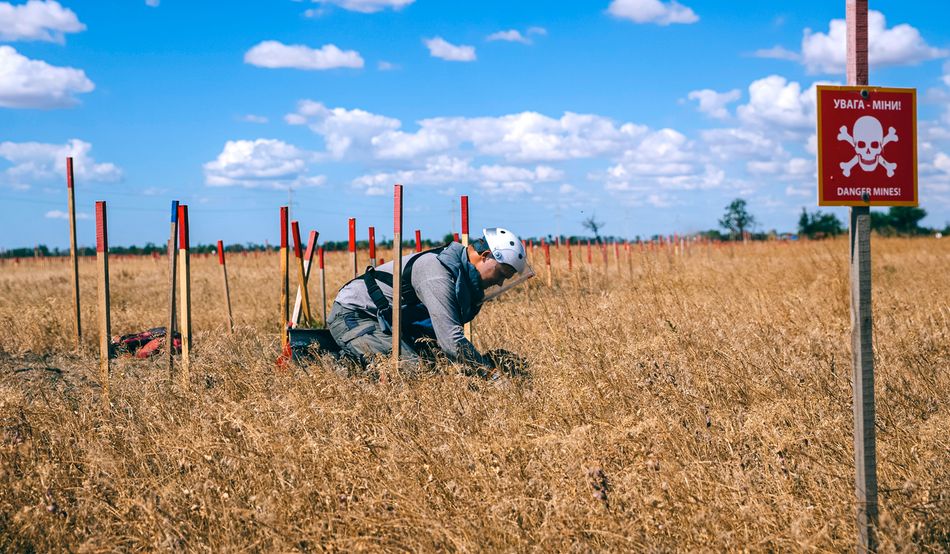
The Karabakh Revival Fund will also provide financial support for restoration and reconstruction in the Azerbaijani territories. A newly created institution, the Demining Agency of Azerbaijan, has begun work despite having no maps of the mined areas, as the Armenian side has failed to provide them.
Azerbaijan is committed to developing green energy in Karabakh. A quarter of Azerbaijan's domestic water resources, which amounts to about 2.56 billion cubic meters (bcm) of water a year, originates in Karabakh. The main rivers of the region, the Tartar, Bazarchay (Bargushadchay), Hakari and other, smaller rivers have great potential for hydropower. Karabakh's solar energy potential is estimated at 3,000-4,000 megawatts and its wind energy potential at 300-500 megawatts.
The Khudafarin and Maiden Tower hydroelectric power stations, built jointly with Iran, will generate 280 MW energy, whereas the planned hydroelectric power plants in the Kalbajar-Lachin area will provide 120 MW of energy, allowing the region to rely on green sources, as these fully meet the region's primary energy needs.
In addition, the thermal water resources of 3093 m3/day in the Kalbajar region and 412 m3/day in Shusha have great potential for the development of green energy.
Azerbaijan has already launched a massive “Reforestation” effort in Karabakh forested areas, and the associated action plan includes the Basitchay and Garagol state reserves, as well as the Lachin, Gubadli, Arazboyu and Dashalti state nature preserves.
It seems that the inflows of the investments from Turkey, Italy, Britain, Pakistan and Israel in the reconstruction of Karabakh are already underway. It estimates that Karabakh has outstanding development potential in “mining”, “metallurgy”, the “creative industries”, the “food industry”, “knitwear”, “tourism”, ‘agriculture” and “green energy”.
Furthermore, the reconstruction of the newly liberated areas of the Karabakh will pave the way for the revival of regional economic and trade relations and the revitalization of transport and communication ties. It will also beneficial for the execution of the development of the “North-South” and “East-West” corridors.
In particular, the European Silk Road, China’s Belt and Road Initiative (BRI), Turkey’s Middle Corridor project and Azerbaijan's transport and logistics capabilities will serve to complement each other in the Nakchivan corridor.
In this connection, the Nakchivan Corridor (NC) will end the isolation of the Nakchivan Autonomous Republic, Azerbaijan’s landlocked exclave, and will, at the same time, embolden Eurasian connectivity.
Azerbaijan is transforming Karabakh into a platform for development, peace and security based on the untapped potential of the region due to which on July 7, 2022 Azerbaijan President Ilham Aliyev signed a decree on the new division of economic regions in Azerbaijan. According to the decree, the number of economic regions increased from 11 to 14. The capital of the country has been allocated to a separate economic region, and the new Karabakh and East Zangazur were created.
The Karabakh economic region covers Khankandi city, Aghjabadi, Aghdam, Barda, Fuzuli, Khojali, Khojavand, Susha and Tartar regions. The other, newly created, Eastern Zangazur region includes the liberated Jabrayil, Kalbajar, Gubadli, Lachin, and Zangilan regions.
Hopefully, the new division of economic regions in Azerbaijan will ensure economic specialization, implementation of effective investment policies and flexible regional management.
It is also important in terms of the reintegration of the liberated territories into the Azerbaijani economy, which requires increasing the efficiency of the work on planning the development of economic regions, ensuring efficiency in economic management, and revising the structure of these economic regions.
Nearly 7000 agriculture establishments in Karabakh were closed, which were providing 24 percent of the grain revenues, 41 percent of liqueur production, 46 percent of the potato growth, 18 percent of the meat production and 34 percent of the milk production of the economy of Azerbaijan. Hopefully it will be redirected towards the socio-economic prosperity of Azerbaijan.
It also possesses various rich deposits of mineral resources such as gold, copper, mercury, chromite, and lead-zinc, which were illegally exploited by Armenia during the occupation.
Restoration of these production capacities will substantially contribute to the development of different economic sectors, especially agriculture. According to preliminary estimates, the newly created East Zangezur economic region alone will be able to form about 4 percent of the Azerbaijani economy in the coming years as it has great opportunities in sectors such as industry, agriculture, livestock, and tourism.
Although during the occupation, the region’s share of the total GDP of Azerbaijan fell to 0.1 percent in the near future it will be possible to produce about $1.76 billion of agricultural and industrial products in the Jabrayil, Kalbajar, Gubadli, Lachin, and Zangilan districts.
The economic development of the Karabakh and East Zangazur economic regions and their access to the international north-south and east-west transport corridors, as well as the Zangezur corridor, will also transform Karabakh into the “economic driver” of the entire South Caucasus. As an economic driver, it will become the symbol of regional cooperation instead of the region of the conflict as it was during the Armenian occupation
The establishment of the Zangazur corridor will help reinvigorate the South Caucasus road network. The corridor will also enable the construction of a railway line between Azerbaijan and Iran, as well as access to Iranian railways. At the same time, the Zangazur corridor will feature a motorway system in addition to trains. So, the creation of this corridor will also allow the opening of a road connection.
The Zangazur corridor and other transit transport corridors provided by Azerbaijan will reshape the world's transportation map. In other words, the new transport infrastructure will gain international status and become a route that Asian and Pacific countries can use.
The corridor will connect Azerbaijan's main territory with the Nakhchivan Autonomous Republic, as well as Turkey, and will provide new prospects for the Turkic world as a whole. The corridor is of fundamental importance in restoring peace, security and cooperation in the South Caucasus.
To conclude, large scale and “Diversified Reconstruction” and completion of these mega projects of transportation, communication, inter-city connectivity, energy, water conservation, rail development, infrastructural, restoration of cultural & heritage sites, immense socio-economic development, smart cities/living and last but not least development, of the newly liberated areas of Karabakh mainly Zangazur and Nakhchivan corridors will bring immense socio-economic dividends in the days to come.
Moreover, newly built air gates of Fuzuli and Zangilan and under construction Lachin’s ariport will further enhance air connectivity of Azerbaijan and will also provide essential “strategic depth” in the days to come.
Araz Valley Economic Zone and Agdam Industrial Park have been operationalized and are open for investors, and entrepreneurs. In this connection, a wide range of incentives will also be provided for entrepreneurs in priority areas, exemptions from tax and customs fees will be introduced, and concessional financing instruments will be applied. Additionally, a mechanism for insuring loans and investments will be created.
With the expansion of usage of environmentally friendly and cost-effective renewable energy sources (RES), the concept of a ‘green energy zone’ will be applied which has great potential for the FDIs.
Ours is the age of economic liberalization, socioeconomic integration, greater regional connectivity and liberalized democracy. In this regard, immense socioeconomic development of newly liberated areas Karabakh would be "stimulator" to all regional countries and their economies too.
It would be "launching pad" for further strengthening of bilateral and trilateral benefiting socio-economic partnerships and geopolitical strategic ties. Hopefully most recently held trilateral meeting of Azerbaijan, Armenia and Russia will be starting point of better understanding in term of peace, stability and prosperity by eradicating the past bitter history and create harmony.
Dr Mehmood Ul Hassan Khan, Executive Director: The Center for South Asia & International Studies (CSAIS), Islamabad. Regional Expert: Azerbaijan & South Caucasus
.jpg.jpeg)