
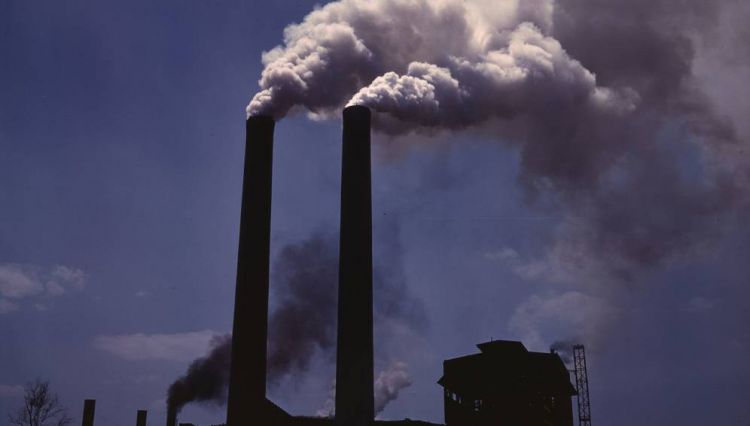
Five national academies of science and medicine have urged the world to adopt concrete measures to tackle air pollution and prevent the millions of deaths it causes each year.
The declaration from the science academies of Germany, Brazil and South Africa, and the science and medicine academies of the United States, was made at the UN headquarters in New York and calls for a global pact to adopt pollution-curbing policies and technologies.
“This call is underpinned by unequivocal scientific evidence on the health impacts of air pollution,” the joint statement said.
Air pollution causes around 7 million avoidable deaths each year, mainly women, elderly people, children and poor people, according to UN Environment, the global environmental authority. It can affect the brain development of children and lead to serious health conditions, including heart disease, asthma, diabetes and cancer.
Luiz Davidovich, President of the Brazilian Academy of Sciences, told SciDev.Net: “The agreement proposes the recognition of the right to clean air and a more effective articulation that guarantees the development of air pollution control strategies that help catalyse investments for the promotion of more sustainable policies.”
In a declaration that will be presented at the UN Climate Summit in New York in September, the academies urged all countries to implement industrial emissions controls and air monitoring systems. Where possible, the successes of individual cities and countries should be shared to help those struggling to improve air quality, they suggested.
The main causes of air pollution are fossil fuel and biomass combustion, which are used for energy generation, heating, cooking, transport and agriculture, according to the joint statement.
Pollution from fossil fuels is particularly harmful to humans, as it contains large amounts of particulate material — especially that with a diameter of less than 2.5 microns (PM2.5), which tends to stay longer in the air than heavier particles. When these particles enter the body they can penetrate the lungs and may even pass into the bloodstream.
Paulo Artaxo from the University of São Paulo’s Institute of Physics, which helped collect and analyse data for the report, told SciDev.Net: “These particles damage the lungs, heart, brain, skin and other organs, increasing the risk of diseases and disabilities.”
To draft the document, experts appointed by the academies analysed data published in recent decades on the impacts of air pollution on human health and the environment.
Paulo Saldiva, a researcher from the University of São Paulo’s Faculty of Medicine, who helped draft the report, said: “This is the first time that science academies from several countries have joined together in a common project to produce a call like this.”
The document stresses that the burning of fossil fuels is the source of two of the main greenhouse gases: methane (CH4) and carbon dioxide (CO2), whose accumulation in the atmosphere is associated with climate change.
“If we control this burning, climate change would also be reduced and it would help to achieve the objective of limiting average global warming to 1.5°C,” explained Artaxo, referring to the global climate goals set out in the 2015 Paris Agreement. The report says 2.4 million deaths would be avoided with this action.
Davidovich explained that there were alternative policies and solutions to reduce the products of combustion, such as ending tax subsidies for the production and consumption of fossil fuels. In Brazil alone, these subsidies amounted to around US$21.2 billion in 2018, according to data from the Institute of Socioeconomic Studies, based in Brasília.
Air pollution causes around 7 million avoidable deaths each year, mainly women, elderly people, children and poor people, according to UN Environment, the global environmental authority. It can affect the brain development of children and lead to serious health conditions, including heart disease, asthma, diabetes and cancer.
Luiz Davidovich, President of the Brazilian Academy of Sciences, told SciDev.Net: “The agreement proposes the recognition of the right to clean air and a more effective articulation that guarantees the development of air pollution control strategies that help catalyse investments for the promotion of more sustainable policies.”
In a declaration that will be presented at the UN Climate Summit in New York in September, the academies urged all countries to implement industrial emissions controls and air monitoring systems. Where possible, the successes of individual cities and countries should be shared to help those struggling to improve air quality, they suggested.
The main causes of air pollution are fossil fuel and biomass combustion, which are used for energy generation, heating, cooking, transport and agriculture, according to the joint statement.
Pollution from fossil fuels is particularly harmful to humans, as it contains large amounts of particulate material — especially that with a diameter of less than 2.5 microns (PM2.5), which tends to stay longer in the air than heavier particles. When these particles enter the body they can penetrate the lungs and may even pass into the bloodstream.
Paulo Artaxo from the University of São Paulo’s Institute of Physics, which helped collect and analyse data for the report, told SciDev.Net: “These particles damage the lungs, heart, brain, skin and other organs, increasing the risk of diseases and disabilities.”
To draft the document, experts appointed by the academies analysed data published in recent decades on the impacts of air pollution on human health and the environment.
Paulo Saldiva, a researcher from the University of São Paulo’s Faculty of Medicine, who helped draft the report, said: “This is the first time that science academies from several countries have joined together in a common project to produce a call like this.”
The document stresses that the burning of fossil fuels is the source of two of the main greenhouse gases: methane (CH4) and carbon dioxide (CO2), whose accumulation in the atmosphere is associated with climate change.
“If we control this burning, climate change would also be reduced and it would help to achieve the objective of limiting average global warming to 1.5°C,” explained Artaxo, referring to the global climate goals set out in the 2015 Paris Agreement. The report says 2.4 million deaths would be avoided with this action.
Davidovich explained that there were alternative policies and solutions to reduce the products of combustion, such as ending tax subsidies for the production and consumption of fossil fuels. In Brazil alone, these subsidies amounted to around US$21.2 billion in 2018, according to data from the Institute of Socioeconomic Studies, based in Brasília.









.jpg.jpeg)