
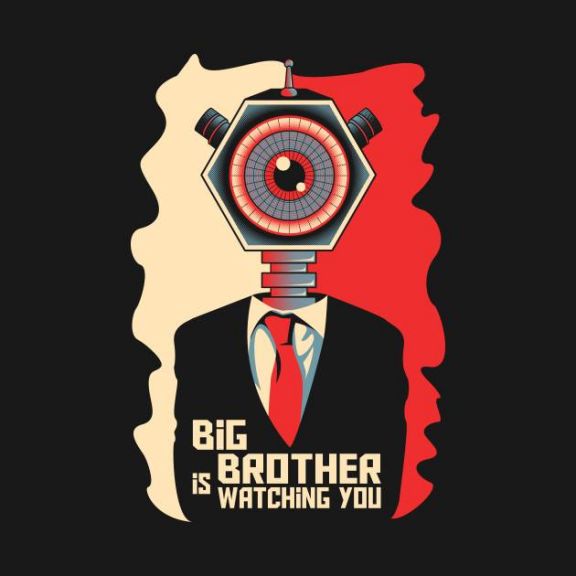
1984 which was written by George Orwell is one of the influential books of all time. Although it was written in 1948 (actually, the title name is opposite of 48 (84)), it was published in 1949. Mainly, this book substantially includes dystopian features, and the genre of the book is political fiction. Even though all events happen in 1984 when there are hypothetical technologies that enable government to control humans’ lives, 1984 is not directly adequate example of science-fiction. Actually, this book mainly analyzes and criticizes certain totalitarian regimes: Nazi Germany and USSR. It should be maintained that in the book, Orwell describes how totalitarian government manipulates media in order to govern people, and how government keeps people under its absolute power. In this paper, 1984 is analyzed primarily according to perspectives on media; in addition, it is discussed how Orwellian understanding on media is applicable not only to totalitarian regimes, but also to democratic regimes.
In 1984, everywhere is full of television. People can watch television; however, government can also watch people’s lives with the help of television (in this world, television also has camera function, television records people’s lives in a secret way). People cannot turn off television because it is prohibited by the party. It should be open all day. People can only watch what is offered by the national TV channel. There are no optional channels that people can change TV channels and watch what they want. Television is regulated by the government. Interests of party are people’s interests, but people’s interests are not interests of the party because the party does not allow people to have their own interests beside ideological interests of the party.
People think in the way that ‘Ingsoc’ (English Socialism) party wants and needs; however, Winston Smith, protagonist, does not think like that. He does not want to accept the way of life offered by the party, and he does not like Big Brother who is leader of the party. He knows ‘Big Brother is watching’ him; therefore, he understands that he should act and speak in the way that Ministry of Truth will not be his next destination. He is just able to write his diary where camera of television does not see him within the scope.

Ironically, he has an office job at a department of Ministry of Truth. Although he is responsible for editing, he can keep documents within a certain period of time. For example, after he finishes editing, he must send documents to adequate places. However, he once keeps document which should be sent to abolish. After reading that, he understands how the government manipulates people mind. Yesterday’s enemy becomes today’s friend, but people do not notice that because the party writes and changes history as they want. People accept that today’s friend was yesterday’s friend too, and they were always ally. People do not judge ‘history’ based on reality because they do not think and question. However, Winston understands that today’s friend was not yesterday’s friend, it was an enemy yesterday. Furthermore, according to Karl Popper’s ‘Correspondence theory of truth’, news is true if it corresponds to a fact; therefore, if news does not correspond to a fact, news should be changed. However, ‘Ingsoc’ party changes fact if it does not correspond to news; in other words, Ministry of Truth manipulates media and changes fact from ‘inappropriate’ form into ‘necessary’ form.
When Winston reads ‘The Theory and Practice of Oligarchical Collectivism’ written by Emmanuel Goldstein who is common enemy of ‘Ingsoc’ party (in a way, he also is common enemy of state and people), Winston is enlightened by the book. However, this book is banned, and Winston must not read this book. Why? Because this is the book explains ‘Ingsoc’ party interest and ideology from analytical and critical perspectives; in other words, the author explains why ‘war is peace, freedom is slavery, ignorance is strength’. Winston understands how international system is structured by three powers (Oceania, Eurasia, and Eastasia), and how the party sustains its absolute power over people.
In this dystopian world, Ministry of Truth controls media to manipulate people mind against rival ideologies and promotes that everything is ‘purely okay’ within the ideology of the party. Unless people touch red lines accepted by the party, people can ‘peacefully’ survive. There are several things that people must not do and must not say. This is 1984. Now, the question arises: is this Orwellian understanding of media applicable only to totalitarian regimes? The answer is both yes and no. Although United States (US) is seen as an example of democratic country from its establishment, the US also followed political prosecution which could be called undemocratic. McCarthyism, which was political practice carried out by US Senator Joseph McCarthy, was not completely different from political prosecution implemented by ‘Ingsoc’ party. In the beginning of Cold War, communists were under the pressure of McCarthyism: people, especially famous Americans, should be careful on what they are saying and doing. At that time, any word can be seen as an allusion. For example, if a person was not communist, but he or she meant something against capitalism, McCarthyism could see his or her words as appreciation of communism. Moreover, is McCarthyism a direct example of democratic regime? Although McCarthyism can be called totalitarian practice within the boundaries of democracy, it was for the sake of defending democracy. Implementation of political prosecution by ‘Ingsoc’ party is also for the sake of defending ideology. Ideologies of McCarthyism and ‘Ingsoc’ party are completely different, but practices of political prosecution are not exactly different.
Gashgay Orujlu
ADA University student



.jpg.jpeg)